Ijen Crater Private Night Tour from Banyuwangi
PrivateTransport includedGate fee included
From $65 per person
The blue fire is the reason people set an alarm for midnight. It is also the most misdescribed thing about this volcano. Knowing what it actually is changes what you book, what time you leave, and how you feel if the wind is wrong.
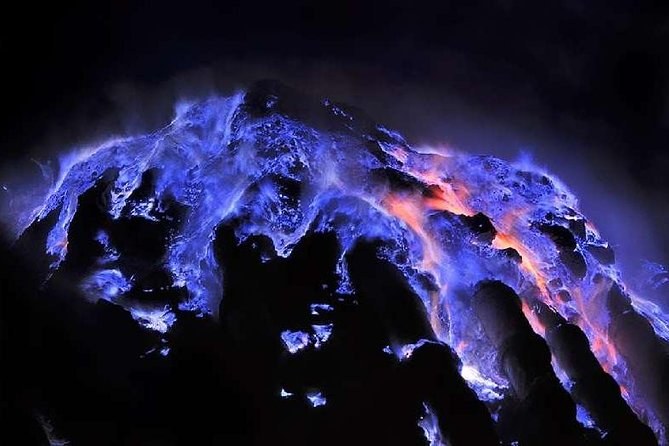
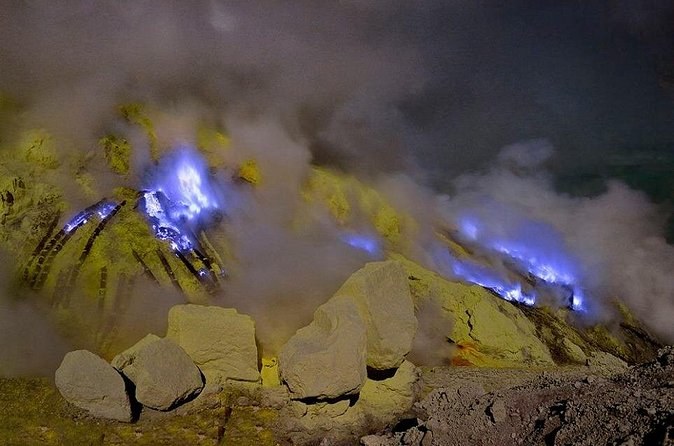
Sulfurous gas. It escapes from vents on the crater floor under pressure and at temperatures reported up to around 600 degrees Celsius, and the moment it meets the oxygen in the air it ignites. What you are looking at is a gas flame, several metres high in places, coming straight out of the ground.
Some of the gas does not burn. It condenses instead into liquid sulfur, which runs downhill glowing red-orange, cools, and sets into the yellow slabs the miners break up. On a good night you see all three states at once: the flame, the liquid running, and the solid already set.
Burning sulfur emits most of its light in the blue part of the spectrum, which is why a sulfur flame looks nothing like a wood fire. Ordinary flames glow orange because they are full of hot soot particles; this one has none, so what reaches your eye is the colour of the chemistry itself.
It is not bright. Photographs make it look like a river of neon because the camera is holding the shutter open for several seconds. In person it is closer to gas-hob blue at the far end of a dark room, and that is exactly why the timing matters so much.
The flames burn continuously, day and night. They are simply outshone. From about half an hour before first light the sky wins and the blue disappears. That is why every departure here is built backwards from a two o'clock arrival, rather than forwards from a comfortable morning start.
That single constraint is what makes a Ijen blue fire tour worth its fare. You are not paying for company on the walk. You are paying for a driver who leaves at the right hour, on a road you do not know, so that you reach the rim while the flames still have the dark.
The phrase gets attached to three different things. Two of them do not happen here at all, and it is worth knowing which before you book.
The first two are not things that happen. The third is what you climb for.
| What people picture | What it actually is | Can you see it at Kawah Ijen? |
|---|---|---|
| Blue lava | Molten rock glowing blue — no such thing occurs here | No. There is no lava anywhere near the trail |
| A river of neon-blue flame | A long-exposure photograph of a modest gas flame | Not with the naked eye. The camera is doing the work |
| Blue flame at the vents | Sulfurous gas igniting as it meets the air | Yes, in darkness, when the vents and the wind cooperate |
Nobody is being dishonest when they post the neon photograph — long exposure is how the flames are always shot. Just arrive expecting a real fire in a real dark place rather than the picture, and it holds up.
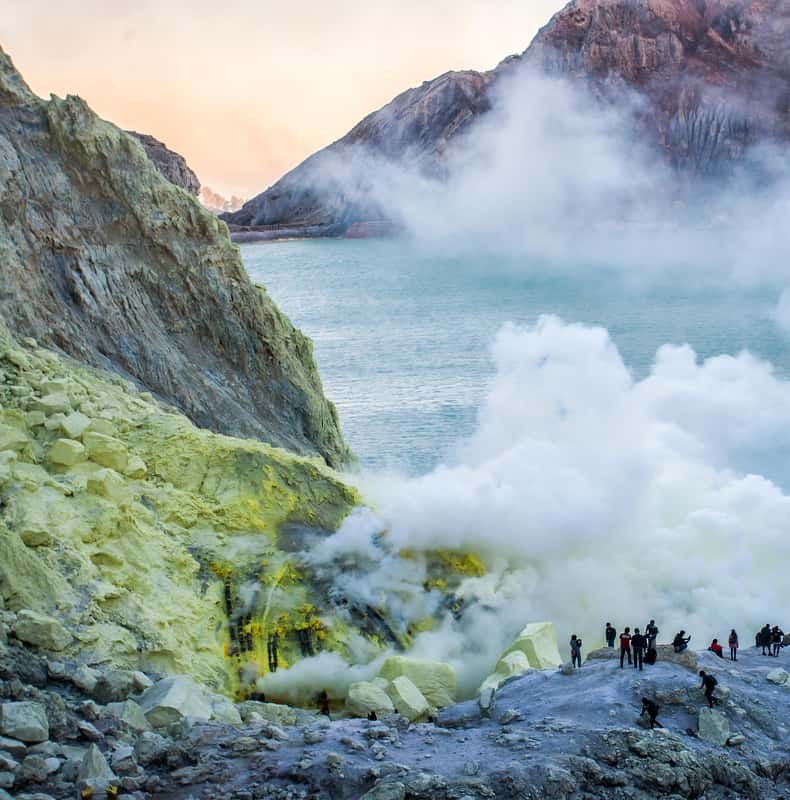
At the vents on the crater floor, at the western edge of the acid lake. That is about a kilometre from the rim path and a couple of hundred metres below it. Getting there means leaving the wide trail for a narrow, steep track of loose rock. It carries two-way traffic and headlamps coming the other way.
Whether your group goes down is not always your decision. Some operators run the descent as a matter of course. Others keep their travellers on the rim, and the park itself restricts how close anyone may get to the working face. The safety page sets out both positions and what the difference means for you.
The flames are not a spectacle laid on for visitors. They are a by-product of a working sulfur mine, and the people beside them at three in the morning are at work. Ceramic pipes run the gas down to condense it. The sulfur sets in slabs, and the slabs are broken out by hand into paired baskets, commonly 70 to 90 kilos a load.
Those baskets then go up the same track you came down and three kilometres back to the road. If you are on the narrow section and a loaded miner is coming through, step off the track on the uphill side and let them past. It costs you four seconds.
Because none of them controls it. The flames depend on the vents, the wind, the cloud and the gas readings. The park closes the crater floor whenever those go the wrong way. Three operators posted notices during 2026 that the flames were temporarily not showing, and one of the warmest reviews here is from a traveller who never saw them at all.
The practical answer is not to gamble. Book a departure that refunds in full at 24 hours. Ask your operator what the crater has been doing that week. Then treat the flames as a bonus on top of a sunrise that happens whatever the vents are doing.
The month-by-month picture is on the weather page, and every departure that gets you there in the dark is on Ijen Volcano Tours.
No, and no honest operator will promise it. The flames are burning gas and they depend on the vents, the wind, the cloud and how dark it still is when you arrive; three operators posted notices during 2026 that they were temporarily not showing. Book for the crater and the sunrise, treat the flames as the bonus, and pick a tour that refunds at 24 hours.
No. It is sulfurous gas escaping the vents at temperatures reported up to around 600 degrees and igniting when it meets the air, which is why it burns blue rather than orange. Some of it condenses into molten sulfur that runs downhill glowing before it sets yellow, and that is what gets photographed and called blue lava. There is no molten rock anywhere near the trail.
Sometimes, and the operators do not agree about it. Some run their groups down the narrow track to the vents; others state that visitors stay on the rim and view from a distance, and the park itself restricts how close anyone may get to the mining area. Ask the operator before you book if getting down to the flames is the point of the trip for you.
Solid sulfur, in twin baskets, commonly 70 to 90 kilos a load. Gas from the vents is piped through ceramic condensers at the water's edge, sets into slabs, and is broken out by hand and carried up the crater path and three kilometres down to the road. It is a working industrial site that visitors happen to walk through, not a display.
From $65 per person
From $101 per person