Kawah Ijen in 24 Hours from Bali, with Dinner and a Room
Hotel pickupGate fee includedFerry included
From $101 per person
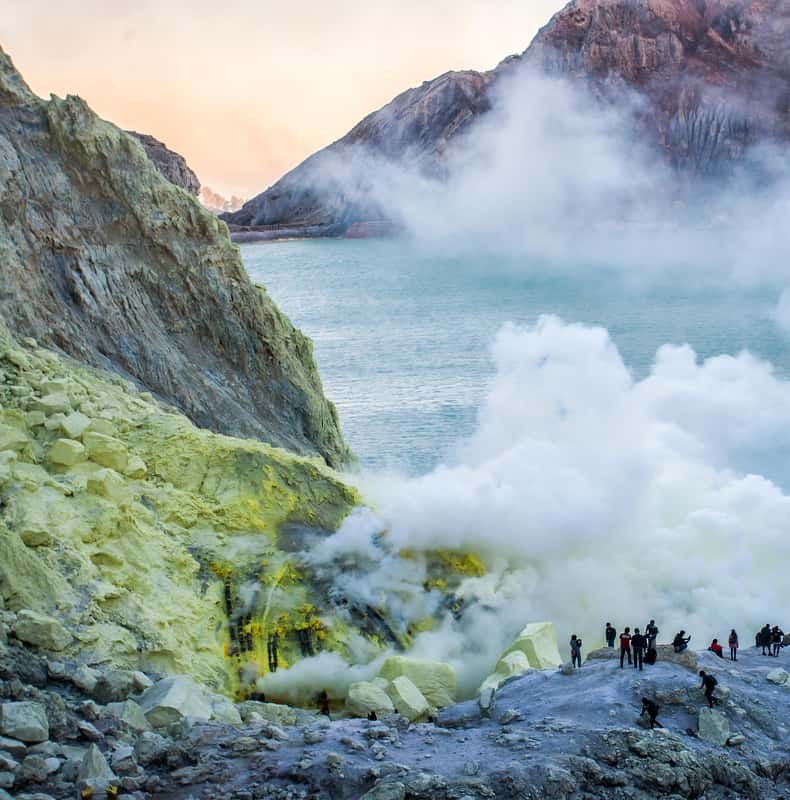
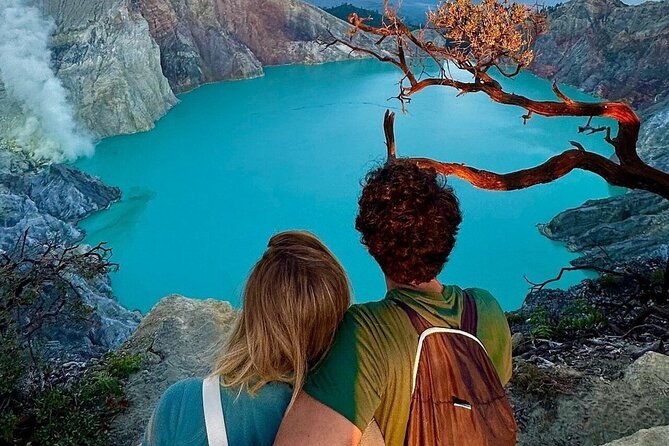
When the light arrives, the flames disappear and a kilometre of turquoise appears in their place. The lake in the crater of Kawah Ijen is the largest highly acidic body of water in the world, and it is the part of this climb that no cloud, wind or gas reading can cancel.
The lake fills the floor of the crater, roughly a kilometre across and about 200 metres deep. Its water sits below pH 0.5 and has been measured close to 0.3 — strong enough to dissolve metal, and far stronger than any lake most visitors will ever stand beside.
What makes it that way is the volcano underneath. Hydrogen chloride and sulfur gases rise through the vent system and dissolve straight into the water, which is why the acidity holds year after year instead of washing out with the rains. A Kawah Ijen volcano tour takes you to the rim above it; nobody takes you into it.
| Measurement | The figure | What it means on the day |
|---|---|---|
| Width | About 1 km across | It fills the view from the rim path |
| Depth | Around 200 m | Deeper than the crater wall is high |
| Acidity | pH below 0.5 | Dissolves metal; nothing lives in it |
| Surface elevation | About 2,145 m | Roughly 240 m below the rim |
| Rim viewpoint | About 2,386 m | Where the trail from Paltuding tops out |
| Highest point of the complex | Gunung Merapi, about 2,799 m | A separate peak — not on any tour here |
Dissolved metals. Iron and aluminium sulfates stay in solution at that acidity, and they are what scatter the light into the colour every photograph of this place carries. It is not algae, which could not survive there, and it is not glacial silt.
The colour is a live thing rather than a fixed one. It reads milky green under flat cloud, hard turquoise in direct sun, and almost grey when the steam is heavy. First light is when most people find it at its best, which is convenient, because that is when you are standing there.
The white column that drifts across the crater is not cloud. It is gas from the vents mixing with water vapour, and it moves with whatever the wind is doing that morning. On a still day it sits over the water; on a breezy one it crosses the rim path and everyone reaches for their mask.
That is worth knowing before you feel it. There is nothing wrong when the steam reaches you and nothing to do about it except put the mask on and keep walking, which is what the guides will tell you as it happens.
Along the shore below the vents runs an array of ceramic pipes. Gas is fed into them, cooled, and comes out the other end as liquid sulfur that pools and sets. The whole arrangement is deliberately simple, because it has to be repaired by hand in a place where nothing mechanical survives long.
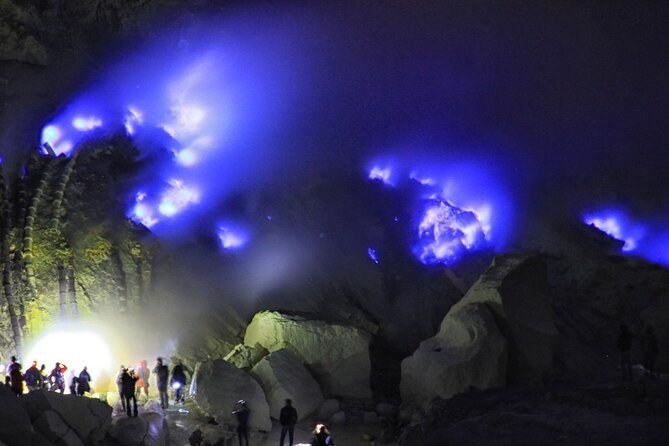
It is the reason there is a path down there at all. The track visitors use to reach the flames is a miners' route first, and the traffic on it is people carrying loads rather than people carrying cameras. The blue fire page covers what happens at the vents themselves.
You can stand near the water where the path allows, watch the pipes working and photograph all of it. You cannot swim, wade, or put a hand in, and nobody who has seen the lake would want to. Operators also differ on whether they take groups down at all, and the park restricts how close anyone gets to the working face.
Camera gear takes a beating down there and so do zips, watch straps and anything else with metal on it. Rinse what you can when you get back down, and keep the mask on when the steam swings your way.
The rim path is the better view anyway. From the top you see the whole oval of the water, the coloured bands on the crater wall and the volcanoes of East Java standing above the cloud behind you. The descent gets you close to the flames; the rim gets you the picture.
If the crater floor is closed on your night, or if the descent is not for you, nothing about the lake is lost. The month-by-month picture shows when the floor is open most often, and every departure that gets you to the rim for first light is listed on Ijen Volcano Tours.
Dissolved metals in acid. The water sits below pH 0.5, which is strong enough to hold iron and aluminium sulfates in solution, and those are what scatter the light that colour. It is not algae and it is not glacial silt, and the colour changes with the light rather than with the season.
The rim path where everybody stands is about 2,386 metres, and the lake surface sits roughly 240 metres below it. The highest point of the whole Ijen complex is Gunung Merapi at about 2,799 metres, which is a separate peak and not where the trail goes. Nobody on a night climb stands on the top of this mountain.
Sometimes, and the operators do not agree about it. Some run their groups down the narrow track to the vents; others state that visitors stay on the rim and view from a distance, and the park itself restricts how close anyone may get to the mining area. Ask the operator before you book if getting down to the flames is the point of the trip for you.
From $101 per person
From $28 per person