Kawah Ijen in 24 Hours from Bali, with Dinner and a Room
Hotel pickupGate fee includedFerry included
From $101 per person
Everything travellers ask before booking a night on Kawah Ijen: the hour you leave, what the fare covers, what the blue fire actually is and whether the crater lake is visible when it is not. Answered from the operators' own listings and from what is published about the volcano. If a question here is not covered, send it over.
Yes, a few days ahead. Almost every departure here runs once a night and fills from a single town, and the cheapest seats go first in the dry months. Two or three days is comfortable outside July and August, and a week is safer inside them.
Two to five days covers most of the year. Almost every tour here refunds in full up to 24 hours before the start, so booking early costs you nothing if the plan moves. One listing needs six days' notice and one is sold final, and both say so on their own card.
Most are, up to 24 hours before the start, for a full refund. Two are not: one takes six days' notice instead, and one is sold final with no refund and no change. Check the line on the card before you pay, because on this mountain a weather cancellation is a real possibility.
Yes. Solo travellers appear right through the reviews on these tours, including on the private night climbs, and one operator's package gives solo bookers a private room at no supplement. None of the listings here states a minimum number of travellers.
Yes, on the tours that carry a 24-hour window, up to 24 hours before the start. Inside that window a change counts as a cancellation. Move a booking as soon as the forecast turns rather than waiting to see.
The operator moves you or refunds you, and this is the reason the cancellation line matters more here than on most trips. The park closes the crater for heavy gas, for bad weather and for one day in the first week of each month. Booking a tour with a 24-hour window is the cheapest insurance available against it.
At the time of booking on most of these, with a mobile ticket, so there is nothing to print. Two listings confirm within 48 hours instead, subject to availability. Several operators also ask you to message them once the booking is made, and it is worth doing the same evening.
You book the tour, and the tour handles the mountain. The park sells its own entry at the gate, but almost every fare here already covers it, and several also cover the health declaration you need before you can start walking. What you are really buying is the driver, the guide, the mask and the 3am logistics.
It is if you want to set the hour you leave, and on this mountain that decides whether you see the flames. Most listings here are private, which means the vehicle leaves when your party is ready rather than when the last seat fills. If you are happy walking with a group and starting when the group starts, the shared departures cost a third as much.
From $26 per person for the midnight climb from Banyuwangi with transport, a guide, the gate fee and a mask. Day trips from Bali run $101 to $134 because a return ferry and sixteen hours of driving sit inside them. The two-to-four-day packages with Mount Bromo run $190 to $507, with beds and meals included.
Almost all of them do, and it is listed in their own Includes block. Three do not, and on those you pay the park directly at the gate. The park charges per person, more at weekends and public holidays than midweek and more for foreign than Indonesian visitors, and the current rate is posted at the ticket window.
Distance and beds, mostly. A $26 departure drives you an hour from Banyuwangi and back in a night; a $101 one crosses the strait by ferry, feeds you and puts you in a room before a 1am start; a $282 one adds Mount Bromo, a waterfall, two nights and a private vehicle. The volcano is the same on all of them.
Transport, a guide and a gas mask on every one of them. Beyond that it varies: most carry the gate fee, six include the Bali ferry both ways, and the multi-day packages add accommodation and breakfasts. Gratuities sit outside the fare everywhere.
Sometimes. A health declaration is required before you start walking, and several fares include the fee while others list it as an extra. Where it is not included your guide still arranges it — it is collected on the drive up, not something you organise at home.
It is a wheeled cart pushed and pulled by miners, for anyone who cannot walk the trail under their own power. No fare here includes it and it is negotiated on the spot: one listing puts it at 50 to 80 US dollars. Bring cash if you think you might want one, because there is nothing to pay by card with at 1,850 metres.
They are not included and they are not compulsory, and almost every listing says so in its exclusions. Guides on this mountain walk it twice in a night with a group behind them, and the reviews suggest most people tip. Small notes are easier than large ones at that hour.
The overnight and multi-day trips do, and the night climbs do not. The 24-hour trips from Bali include a Javanese dinner before you sleep and breakfast after you come down. The Banyuwangi night climbs include water, coffee and in one case fried banana, which is exactly the right amount of food for a 1am start.
On six of the seven Bali departures, both ways. It is the Gilimanuk to Ketapang crossing and it takes about an hour, plus whatever the queue is doing that night. Where the ferry is not listed in the Includes block, budget for it separately.
Between 11pm and 1am, depending on where you are collected. Banyuwangi departures leave town around midnight; the Bali trips wake you at your guesthouse an hour from the gate. The trail itself opens for night walkers around 1 to 2am, and the flames stop being visible as soon as the sky lightens.
Three kilometres and about 500 metres of ascent, on a wide track, in the dark. Most people take an hour and a half and every operator here budgets for that. The part that surprises people is the optional descent to the crater floor: a kilometre of narrow, steep, loose rock, and the same again coming back up.
About ninety minutes to the rim at a steady pace, and reviewers who moved faster report an hour. Add thirty minutes each way if you go down to the vents. Coming back down to the gate takes about an hour, so the whole thing on the mountain is four to six hours.
You need one, and every fare here provides one. The vents give off sulfur dioxide that will make you cough and stream at the eyes, and the wind decides how much of it reaches the path. Wear it when your guide says to, not when it starts to hurt.
Proper shoes with grip, long trousers and a warm layer you can take off. It is genuinely cold on the rim before dawn at 2,386 metres and warm again by the time you reach the gate at eight. Several operators lend a jacket, a beanie and gloves free of charge if you ask when you book.
It depends on the operator, and the rules genuinely differ. One sets a minimum age of 15, another 18, and one takes under-tens only under conditions; several simply require an adult with them. One reviewer walked it with a 10-year-old and a 13-year-old who both managed the distance without difficulty.
Yes, and more often than most visitors expect. The crater shuts for one day in the first week of each month, and the park closes it at any time when the gas readings or the weather call for it — one reviewer's group arrived after a two-month closure. Book a departure that refunds at 24 hours and check your date with the operator.
Yes, and seven of the listings here are built to do exactly that. The short version is a 5-to-7-hour night dash with a return ferry; the comfortable version is 24 hours with dinner, a bed in Java and a 1am start an hour from the gate. Both cross at Gilimanuk and come back the same way.
At the gate, yes; above it, no. Paltuding has warungs selling coffee, noodles and snacks, and small stalls sell gloves and hats to people who underestimated the cold. Once you start walking there is nothing for three kilometres, so fill your bottle before you set off.
No, and no honest operator will promise it. The flames are burning gas and they depend on the vents, the wind, the cloud and how dark it still is when you arrive; three operators posted notices during 2026 that they were temporarily not showing. Book for the crater and the sunrise, treat the flames as the bonus, and pick a tour that refunds at 24 hours.
Sometimes, and the operators do not agree about it. Some run their groups down the narrow track to the vents; others state that visitors stay on the rim and view from a distance, and the park itself restricts how close anyone may get to the mining area. Ask the operator before you book if getting down to the flames is the point of the trip for you.
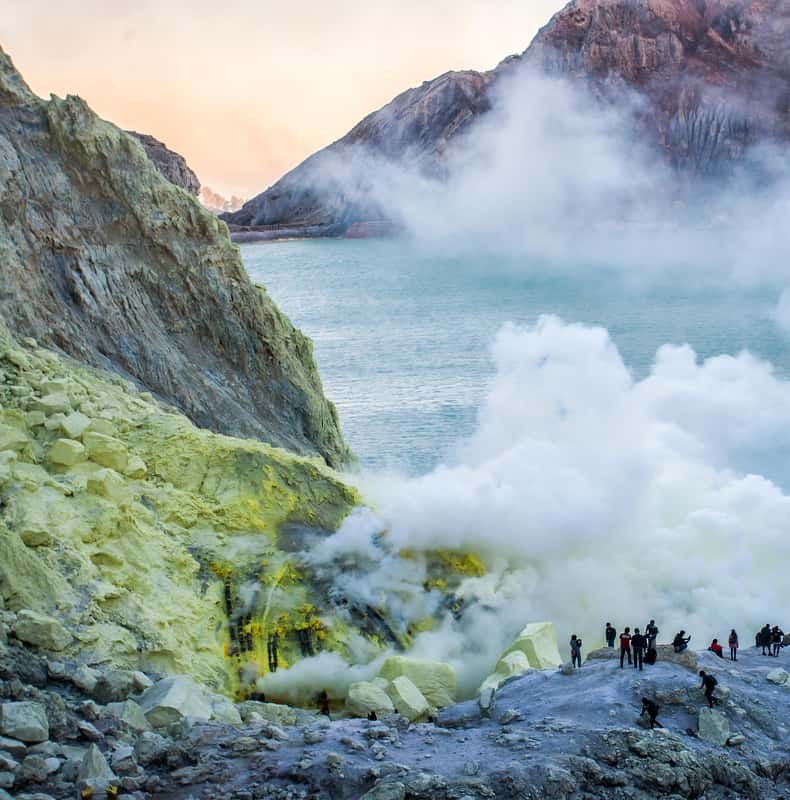
No. It is sulfurous gas escaping the vents at temperatures reported up to around 600 degrees and igniting when it meets the air, which is why it burns blue rather than orange. Some of it condenses into molten sulfur that runs downhill glowing before it sets yellow, and that is what gets photographed and called blue lava. There is no molten rock anywhere near the trail.
Dissolved metals in acid. The water sits below pH 0.5, which is strong enough to hold iron and aluminium sulfates in solution, and those are what scatter the light that colour. It is not algae and it is not glacial silt, and the colour changes with the light rather than with the season.
The rim path where everybody stands is about 2,386 metres, and the lake surface sits roughly 240 metres below it. The highest point of the whole Ijen complex is Gunung Merapi at about 2,799 metres, which is a separate peak and not where the trail goes. Nobody on a night climb stands on the top of this mountain.
Solid sulfur, in twin baskets, commonly 70 to 90 kilos a load. Gas from the vents is piped through ceramic condensers at the water's edge, sets into slabs, and is broken out by hand and carried up the crater path and three kilometres down to the road. It is a working industrial site that visitors happen to walk through, not a display.
Still deciding which one to take? Compare the Ijen Volcano tours side by side, read how a night on the mountain works, or start with Ijen Volcano Tours.
From $101 per person
From $28 per person