Kawah Ijen in 24 Hours from Bali, with Dinner and a Room
Hotel pickupGate fee includedFerry included
From $101 per person
Three things decide how this visit goes, and none of them is fitness. The hour you leave. Whether the crater floor is open that night. And whether the fare you booked already covers the four separate things you would otherwise be paying for in cash at 1,850 metres.
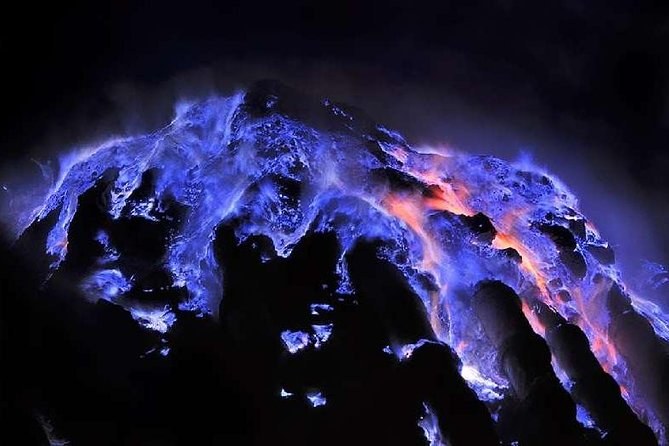
The blue flames are only visible against darkness. That single fact sets the whole timetable: gate around one or two in the morning, ninety minutes up, half an hour down into the crater if your group is going, and back on the rim for the light at about half past five.
Departures from Banyuwangi leave town between 11pm and half past midnight. Trips starting in Bali leave the previous afternoon, cross the strait on the evening ferry and put you in a bed an hour from the gate. Reviewers who set off in the first wave describe standing at the vents; reviewers who arrived in the middle of it describe a queue on a narrow track. How the night is timed lays out the whole sequence.
Three kilometres and about 500 metres of ascent, on a wide graded track, in the dark. Ninety minutes is the honest average and an hour is a fast one. It is a steady climb rather than a scramble, and the people who struggle are almost always those who set off quickly in the cold.
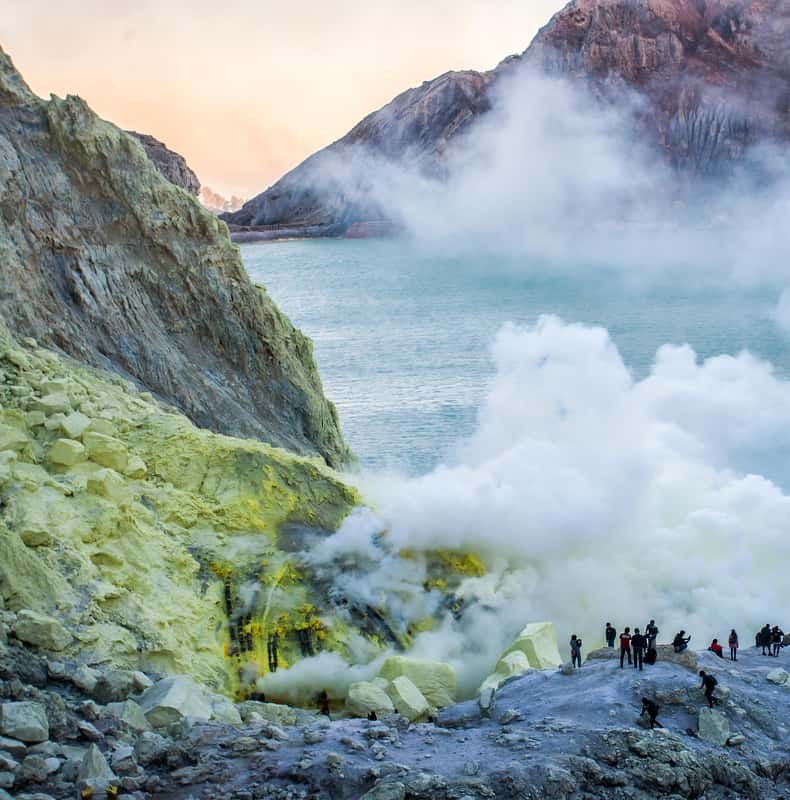
The descent to the flames is a different question: roughly a kilometre of narrow, steep, loose rock with two-way traffic on it, and the same again coming back. One traveller measured the whole night at about ten kilometres with that detour included. Whether your group does it at all depends on the operator and on what the park allows that night, which the safety page covers in full.
The park charges a per-person entrance fee at Paltuding. It is higher at weekends and public holidays than midweek, and higher for foreign visitors than for Indonesian ones, and the current rate is posted at the window. Almost every fare listed here already covers it. Two other costs sit outside most fares.
Nothing above is negotiable at the gate except the trolley.
| What you pay for | Typically inside the fare? | What to check before you book |
|---|---|---|
| Park entry at Paltuding | Yes, on almost every departure | The Includes block on your own listing |
| Health declaration | Sometimes | It is collected on the drive up either way |
| Gas mask and headlamp | Yes, on every one | Nothing — this one is universal |
| Trolley taxi | No | 50 to 80 US dollars, cash, on the spot |
| Meals | On the overnight and multi-day trips | Night climbs carry water, coffee and a snack |
| Ferry from Bali | On six of the seven Bali departures | Whether it is listed both ways |
The spread from $26 to $507 is not a quality spread. It is distance and beds. A twenty-six dollar departure drives you an hour from Banyuwangi and back in a night; a hundred-dollar one crosses to Java, feeds you and gives you a room before a 1am start; a five-hundred-dollar one buys a whole private vehicle for three days with Mount Bromo attached. Book Kawah Ijen volcano tour and the arithmetic is done for you.
Because nobody controls it. The flames are burning gas, and they depend on the vents, the wind, the cloud and how dark it still is when you arrive. Three operators posted notices during 2026 that the flames were temporarily not showing.
That is a reason to book carefully rather than a reason not to go. The crater, the sunrise and the acid lake happen whatever the vents are doing, and two reviewers in the pool rated their night five stars having seen no flame at all. What the blue fire actually is, and why nobody controls it, is on its own page.
Kawah Ijen closes for one day in the first week of every month. On top of that, the park closes the crater floor whenever the gas readings rise, and the whole trail when the weather makes it unsafe. One traveller's group arrived the day after a two-month closure.
The way to make that cost nothing is the cancellation line. Almost every departure here refunds in full at 24 hours, so a forecast that turns is an inconvenience rather than a loss. The booking questions cover what happens to a booking in each case.
Not company. On a mountain where several hundred people set off within twenty minutes of each other, a guide is a pacing decision and a positioning decision. The ones travellers name in their reviews — Qim Qim, Sule, Malik, Aldo, Ekshal, Yoga, Jee — are named for the same reason every time: they got their group moving early and kept them out of the bottleneck.
The second job is the mask and the gas. Nobody on the trail can tell where the plume is about to go; a guide who walks it nightly can, and will tell you to put the mask on before you would have thought of it. The third is the paperwork: the health declaration, the gate, and the driver who is still awake at eight in the morning.
Two or three days is comfortable for most of the year. July and August are the exception — those are the months when several hundred people are on the trail on a single night, when Banyuwangi accommodation fills, and when the cheapest seats go first.
Confirm the collection point the evening before, in writing. Several operators ask for a message once the booking is made and it is worth sending. The one recurring complaint in the review pool across every product here is a pickup that was never confirmed, and it is five minutes of work to rule out.
Banyuwangi is an hour from the gate and cheapest by a wide margin. Bali is a ferry and most of a day away, and the trips built for it either dash across in five to seven hours or give you a bed and two meals in Java. Surabaya, Malang and Yogyakarta are six to seven hours of road, which is why every departure from those cities is a multi-day trip with Mount Bromo attached.
None of those is the right answer in the abstract; it depends where the rest of your holiday is. Bali against Banyuwangi does that comparison properly, and the map page has the roads and the crossing.
Pick the departure point first and the fare second. The hour you leave is worth more than the money you save. Every departure is on Ijen Volcano Tours.
From $101 per person
From $65 per person