Kawah Ijen in 24 Hours from Bali, with Dinner and a Room
Hotel pickupGate fee includedFerry included
From $101 per person
Almost everything a visitor believes about this volcano before arriving is slightly wrong, and the corrections are more interesting than the originals.
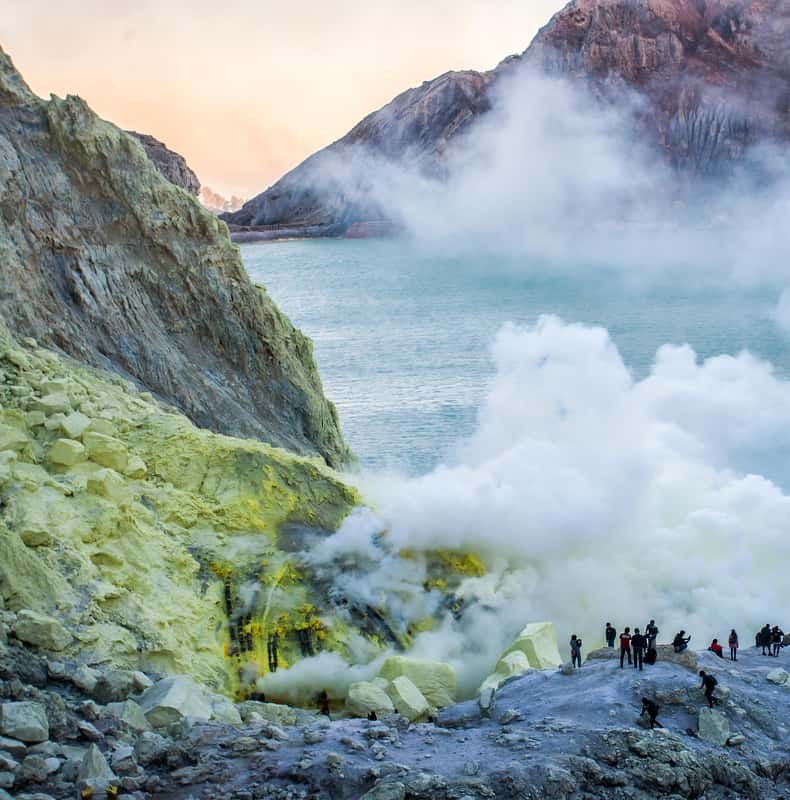
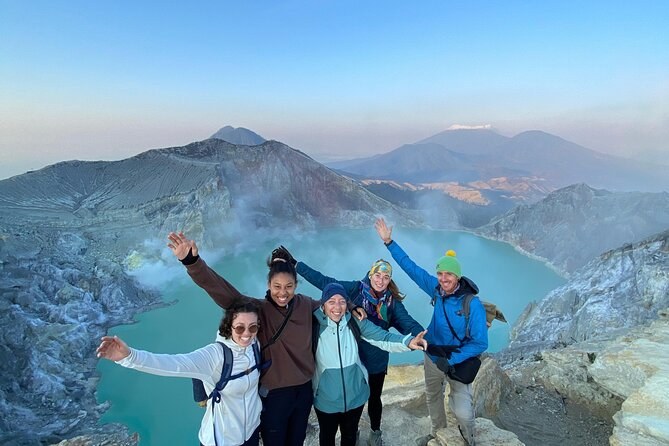
A kilometre across and roughly 200 metres deep, sitting below pH 0.5 and measured at times close to 0.3. That is stronger than the acid in a car battery. Nothing lives in it, nothing grows around its edge, and the metal on a camera strap does not enjoy the morning.
What keeps it that way is the volcano underneath, feeding hydrogen chloride and sulfur gases straight into the water year after year. The chemistry and the measurements are set out in full.
Sulfurous gas comes out of the vents at temperatures reported up to around 600 degrees and ignites the moment it meets the air. Burning sulfur emits most of its light in the blue part of the spectrum, which is why it looks nothing like a wood fire.
There is no blue lava anywhere on this mountain, and no molten rock within reach of the trail. The phrase persists because a long-exposure photograph of a modest gas flame looks exactly like a river of neon. What is actually burning untangles the three things people mean.
Every published image of the flames was shot with the shutter open for seconds at a time. With the naked eye it is closer to a gas hob at the far end of a dark room. That is not a disappointment if you know it in advance, and it is exactly why the hour you arrive matters so much.
Sulfur sets into slabs at the condensers, is broken out by hand, and goes into paired baskets slung on a shoulder pole. A full load commonly runs 70 to 90 kilos — more than most of the people carrying it weigh — and it goes up the crater path and three kilometres down to the road.
They do it twice a night, past several hundred visitors with cameras. Standing aside on the narrow section costs you four seconds and it is the single most useful thing you can do up there.
The rim path tops out at about 2,386 metres. The highest point of the Ijen complex is Gunung Merapi at roughly 2,799 metres, a separate peak that no tour here climbs. Nobody on a night climb stands on top of this mountain, and the view is better where they do stand.
Paltuding is a car park at the end of a road, 500 vertical metres below the rim. Every photograph you have seen of this place was taken after a ninety-minute walk that no itinerary can skip. Where everything actually is sorts out the geography.
One day in the first week of each month, for a local ceremony, and on top of that whenever the gas readings or the weather call for it. It is a working mountain with a working mine, not an attraction with opening hours.
The flames need vents, wind and darkness to cooperate. The light arriving over a kilometre of turquoise water does not. Two reviewers in the pool never saw a flame and rated their night five stars, which is worth remembering when you are choosing a fare.
This is an active volcano, monitored continuously, with an alert level that can and does close the crater. What it has not done in living memory is anything dramatic. The activity you meet on a climb is gas, heat and acid rather than eruption, which is the whole reason several hundred people can walk into the crater on an ordinary Tuesday night.
The crater walls are banded yellow, grey, orange and red from sulfur and iron deposits, and in the first hour of light they carry more colour than the lake does. Most visitors are looking down at the water and miss the wall behind them until they turn round on the way back along the rim.
On a clear day you can see the mountains of Java from the west coast of Bali, and that proximity is misleading. The crossing is an hour, the drive from Ketapang is another, and then there is the climb. That gap between how close it looks and how long it takes is the single most common planning mistake made about this volcano.
Kawah is Indonesian for crater. Kawah Ijen is simply the crater of Ijen, and the wider bowl the whole thing sits inside — a caldera some sixteen kilometres across, holding several separate peaks — is the Ijen complex. Tour listings use Kawah Ijen, Mount Ijen and Ijen Crater interchangeably for the same night out, which is worth knowing when two listings look like different products and are not.
Sulfur off this mountain goes into industry rather than into souvenirs: bleaching sugar, processing rubber, making fertiliser and matches. The carved sulfur figures sold at the gate are a side trade run by the same men, and buying one is the most direct thing a visitor can do for the people they have spent the night photographing.
| Fact | The figure |
|---|---|
| Crater rim viewpoint | About 2,386 m |
| Lake surface | About 2,145 m |
| Trailhead at Paltuding | About 1,850 m |
| Highest point of the complex | Gunung Merapi, about 2,799 m |
| Lake width | About 1 km |
| Lake depth | Around 200 m |
| Lake acidity | Below pH 0.5 |
| Gas temperature at the vents | Reported up to about 600 °C |
| A miner's load | Commonly 70–90 kg |
| Walk to the rim | 3 km, about 500 m of ascent |
Every departure that gets you up there is on None, and the month you pick changes what you see more than the operator does.
Read these before you go and the mountain gets more interesting rather than less. The corrections are the good part. Every departure is on Ijen Volcano Tours.
From $101 per person
From $282 per person