Ijen Crater Private Night Tour from Banyuwangi
PrivateTransport includedGate fee included
From $65 per person
This volcano has no rooms to walk between. What it has is a sequence of stages, each with its own character, and knowing them in advance is the difference between a night that feels long and one that feels well spent.
A car park at the end of a mountain road, with a ranger post, a ticket window, a row of warungs and a great many minibuses. Between midnight and two it fills, headlamps come on, and several hundred people wait at a barrier in the cold.
Use the toilets, fill your bottle and check your torch here, because none of the three exists again until you come back down. Everything that is and is not at the gate covers it in detail.
Wide, compacted and steeper than it looks in the dark. This is where the field spreads out, and it is also where most people make their one mistake of the night by walking too fast in the cold. Twenty minutes of deliberately easy pace pays for itself twice over later.
You will pass a weighbridge and a shelter where the miners' loads are weighed. It looks like nothing at two in the morning. On the way down, in daylight, it is one of the more sobering things on the mountain.
Two kilometres of steady gradient with the smell of sulfur arriving and leaving on the wind. Nothing technical, no scrambling, just up. Ninety minutes from the gate is the average and every operator budgets for it.
If the wind swings, the smell arrives before anything else does. That is the moment to put the mask on rather than the moment to worry — what the gas does and what handles it explains why it is uncomfortable rather than dangerous on the trail itself.
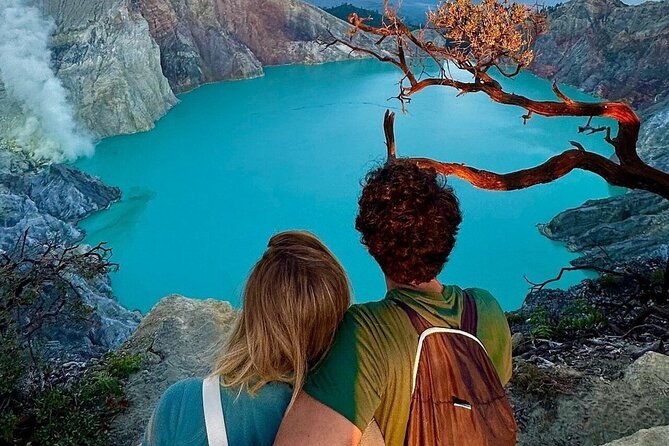
The track tops out and the ground falls away in front of you. In the dark you see headlamps below and, if the vents are cooperating, blue light at the bottom. In the light you see the whole crater: a kilometre of turquoise, banded walls, and the volcanoes of East Java standing above the cloud behind you.
Most of the photographs that made you want to come here were taken from this stage rather than from the crater floor. That matters if you are deciding whether to go down. The lake and its measurements are worth reading before you stand over it.
About a kilometre of narrow, steep, loose rock, with people coming up as you go down and loaded miners passing in both directions. Thirty minutes down, forty back up, and the only stage of the night that some operators simply do not run.
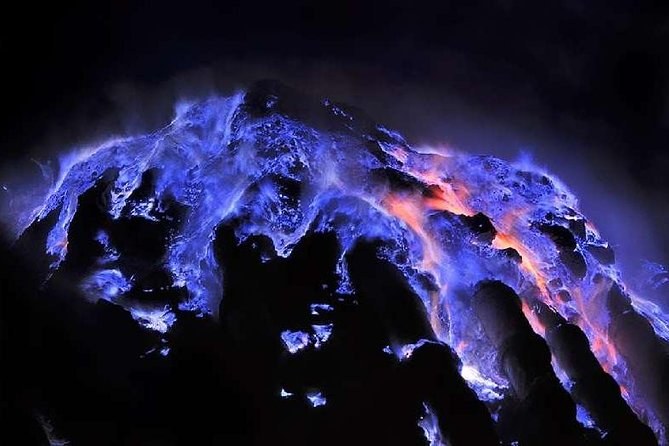
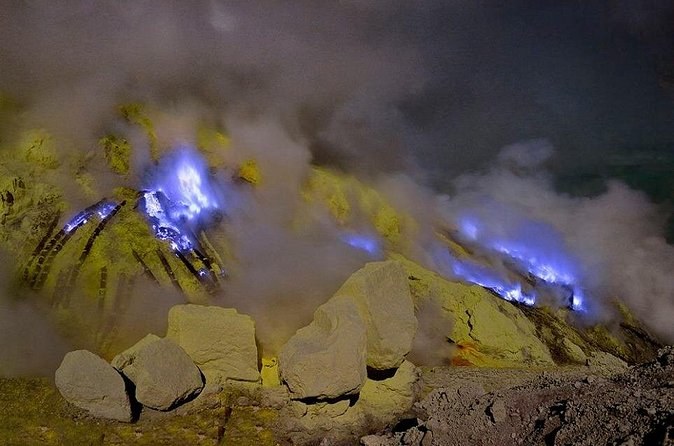
At the bottom are the ceramic pipes, the liquid sulfur, and the flames. It is a working mine rather than a viewing platform, and the etiquette is simple: step to the uphill side and let a loaded basket through. What burns down there is the whole reason for the hour.
Just above the car park there is a shelter with a set of scales. In the dark it reads as a hut. In daylight, on the way down, it is where the loads are weighed and paid for, and it is usually the moment the walk stops being a hike and starts being somebody's workplace.
A full basket pair commonly runs 70 to 90 kilos. It comes up the same narrow track you walked down, then three kilometres to the road, twice a night. Nothing about the mountain is more worth a minute of your attention, and what happens at the vents explains where it all comes from.
The rim-only version runs about four hours on the mountain: ninety minutes up, an hour or so at the top, an hour down. Add the crater floor and it becomes five to six, because the descent is slow in both directions and the queue at the narrow section is real in the dry months.
Neither version is a race. Departures build in the margin, and the only decision that genuinely costs you time is starting late. That is the argument for the departures that leave Banyuwangi at eleven rather than at one.
An hour, and completely different from the way up because you can see it. The banded walls, the miners on the track with their loads, the forest below the gate and, on a clear morning, the strait and Bali beyond it.
You land back at the warungs somewhere between seven and nine, and the coffee at that point is one of the small pleasures of the trip. Then it is the drive back, a shower, and on most itineraries a breakfast that somebody else has already arranged.
Ten kilometres all in, if you take the crater floor. Seven if you do not.
| Stage | Distance | Time | Optional? |
|---|---|---|---|
| Paltuding car park | — | 20–60 min waiting | No |
| First kilometre | 1 km | 20–30 min | No |
| The long climb | 2 km | 50–70 min | No |
| The rim | — | 30–90 min | No |
| Down to the vents and back | About 2 km | 60–80 min | Yes |
| Descent to the gate | 3 km | About 60 min | No |
Whichever version you do, the shape is the same and every departure on Ijen crater tour is built around it. If you would rather read the night as a clock than as a map, the hour-by-hour guide does that instead.
Read the stages before you go and the night stops being a blur of headlamps. The rim is the destination; the crater floor is the extra. Every departure is on Ijen Volcano Tours.
From $65 per person
From $28 per person