Ijen Crater Private Night Tour from Banyuwangi
PrivateTransport includedGate fee included
From $65 per person
Nobody tells you what the night is shaped like before you book it, and it is a strange shape: two hours of waiting, four hours of walking, and about forty minutes that everybody came for. Here it is hour by hour.
Between eleven at night and one in the morning, depending on where you are collected. Banyuwangi departures leave town around midnight. Trips that started in Bali the previous afternoon wake you at a guesthouse an hour from the gate. The multi-day packages drive from Bondowoso or a village on the western side.
Whichever it is, the target is the same: be at the Paltuding barrier when it opens for night walkers. Everything before that is logistics and everything after it is the mountain.
An hour of switchbacks from Banyuwangi through Licin, or a little more from Bondowoso on the other side. This is where the health declaration is collected on most itineraries, at a clinic or a checkpoint, while you stay in the vehicle.
Sleep if you can. Almost nobody does, and almost everybody regrets it around four in the morning.
A car park at about 1,850 metres, filling with minibuses, headlamps and the smell of instant noodles from the warungs. This is the last chance for a toilet, a coffee and a filled water bottle, and it is where the stalls sell gloves and hats to people who packed for a beach.
The waiting is real and it is cold. Twenty minutes to an hour, depending on how early your driver was, standing at a barrier with several hundred other people. What is and is not at the gate covers the practicalities.
The barrier lifts and the whole car park moves at once. The first kilometre is steeper than it looks in the dark and this is where the field spreads out, mostly according to who went off too fast.
Walk the first ten minutes slower than feels natural. It is the single most useful thing you can do with this hour, and everybody who has climbed this mountain twice does it the second time.
Ninety minutes and three kilometres later the track tops out and the ground disappears in front of you. In the dark you see headlamps strung out below and, if the vents are cooperating, blue light at the bottom of the hole.
It is cold up here, properly, with wind on it. This is the layer you have been carrying for two hours finally earning its place in the bag.
That depends on your operator and on the park. Where the descent runs, it is about a kilometre of narrow, steep, loose rock with two-way traffic and loaded miners coming through, and it takes half an hour down and rather more coming back.
Where it does not, you stay on the rim and watch the flames from above. Some operators keep their groups up there as a matter of policy, and the park itself restricts how close anyone gets to the working face. Where that line sits is worth reading before you book if the descent is the point for you.
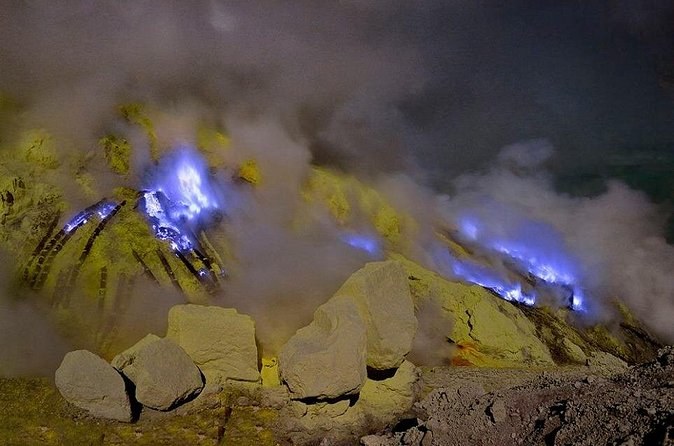
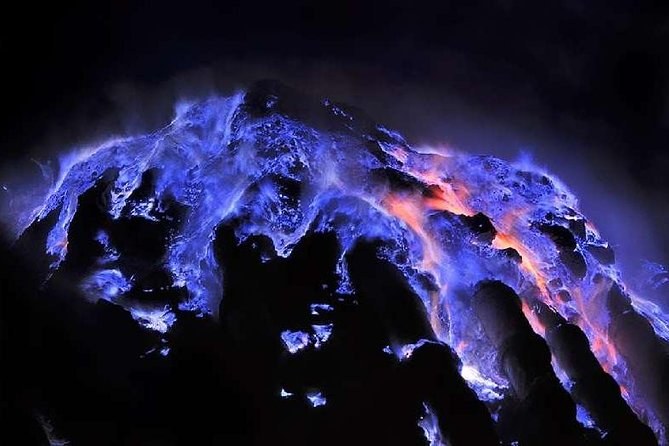
Real fire in a real dark place, a few metres high, blue rather than orange because it is burning sulfurous gas and not wood. It is fainter than the photographs, which are all long exposures, and it is more affecting than the photographs, which cannot carry the noise or the heat or the men working in the middle of it.
Twenty minutes to half an hour is what most groups get before the sky starts to change. What the blue fire is, and why the window is so narrow, is on the blue fire page.
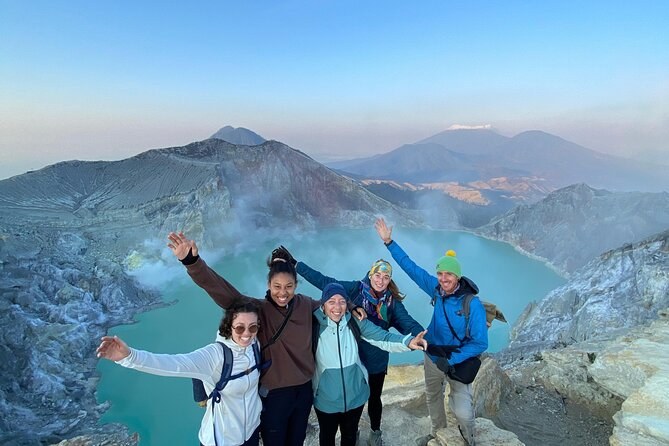
Back on the rim, and this is the part nobody expects to be the highlight. The light arrives, the crater fills in, and a kilometre of turquoise water appears where there was a black hole. Behind you the volcanoes of East Java stand above a layer of cloud.
This is also the part that cannot be cancelled by the wind. Two travellers in the review pool never saw a flame at all and rated their night five stars because of this half hour. The lake and its measurements are worth knowing before you stand over it.
An hour, and a completely different walk because you can see it. The banded crater wall, the miners on the track with 70 to 90 kilos on a shoulder pole, the forest below the gate and, on a clear morning, the strait with Bali on the far side.
The weighbridge you walked past in the dark makes sense now. So does the trolley taxi, coming down with somebody in it.
Back at the car park, and the coffee at this point is out of all proportion to what it costs. Most itineraries then drive you to a shower and a breakfast: the overnight trips hold a room for you, the multi-day ones move on to the next site, and the night climbs from Banyuwangi drop you at your hotel or the ferry.
Standing still, mostly, and it is the part of the night nobody warns you about. Your driver aims to arrive before the barrier lifts, because arriving after it is how groups end up in the middle of the wave. That means twenty minutes to an hour in a cold car park at 1,850 metres with several hundred other people doing the same thing.
Use it. Buy a coffee at the warungs, use the toilets, fill your bottle, and check your headlamp works while there is still someone around to lend you a spare. It is the last opportunity for any of those things for the next five hours, and the gate page lists what is and is not up there.
Warm at the car park, cool on the climb because you are working, and genuinely cold on the rim once you stop moving. That last transition is the one that catches people: you arrive at half past three having sweated through a t-shirt, stand still for forty minutes, and discover that 2,386 metres before dawn is a different climate from the one you left in Bali.
Carry the layer rather than wearing it up. Several operators lend a jacket, gloves and a beanie free of charge if you ask at the point of booking, and the stalls at Paltuding sell all three to people who did not.
Every departure listed here is built to roughly this timetable.
| Time | Where | What is happening |
|---|---|---|
| 23:00–01:00 | On the road | Collection, the drive, the health declaration |
| 01:00–02:00 | Paltuding | Waiting at the barrier in the cold |
| 02:00–03:30 | The trail | 3 km and 500 m of ascent in the dark |
| 03:30–04:00 | The rim | The first view down into the crater |
| 04:00–05:00 | The crater floor | The flames, where the descent runs |
| 05:00–06:00 | Back on the rim | Sunrise over the lake |
| 06:00–07:30 | The descent | An hour down, in daylight |
| 07:30–09:00 | Paltuding, then the road | Coffee, then the drive back |
Read it once before you go and the night stops being a blur of headlamps. Every departure on Ijen blue fire tour runs to this shape, and the stage-by-stage version covers the same ground as a map rather than a clock.
Three things, and all of them are the park's decision rather than your operator's. The barrier can open late if the gas readings are high, which pushes everything back by an hour and occasionally cancels the descent. Cloud can arrive and remove the sunrise. And on one day in the first week of each month the mountain does not open at all.
None of that is a reason to build a rigid plan around a single night. Book something that refunds at 24 hours, keep a spare morning if the trip allows one, and treat the timetable above as the shape rather than the schedule. The month-by-month page shows when the odds are best.
Every departure that runs to this timetable is listed on Ijen Volcano Tours.
Eight to fourteen hours depending on where you start. From Banyuwangi it is typically ten to twelve, with about four of those on the mountain. From Bali it is a full twenty-four hours if you take the version with a bed in it.
Between twenty minutes and an hour at the gate, and that is the only real waiting in the night. It is cold, it is dark and there is coffee for sale, which is why so many operators time their arrival for just before the barrier lifts.
In the small hours, and travellers consistently describe a two o'clock opening. It is set by the park rather than by the operators, and it can move on the night if the gas readings are high.
No, but you do need to set off early. Ninety minutes at an ordinary pace is plenty; what costs people the flames is arriving at the gate late and joining the back of the wave.
You can climb in daylight and one traveller describes doing exactly that with a private guide, having the crater almost to themselves. You will not see the flames, because they need darkness, but you will see the lake and the crowd will be gone.
From $65 per person